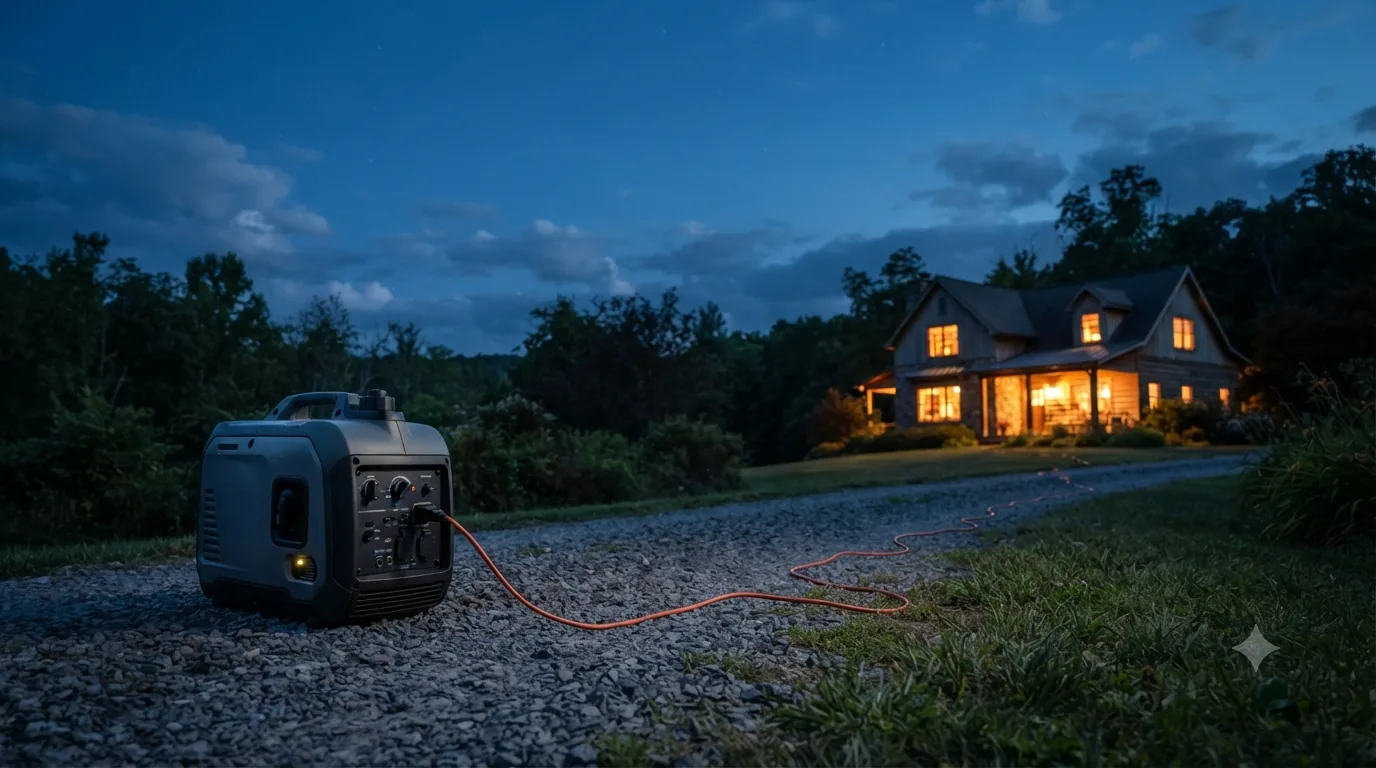
Portable Generators, Decoded
Generator Decoded exists to fix two specific confusions the marketing never explains: generators are sold on peak/surge watts, not the running watts that actually limit what you can power all day — and published noise (dB) ratings are measured at wildly inconsistent, often unstated distances, making side-by-side comparisons meaningless. We don't publish prices or star ratings, every pick names an honest drawback, and every fact is sourced.
Every generator's box says "10,000 Starting Watts!" in huge type and buries the running-watt number in the fine print — because a fridge, well pump, or window AC needs 2-4x its steady draw just to switch on. Our Startup Watt Index puts real running-vs-starting numbers next to the appliances people actually try to power. And when it comes to noise, our Generator Noise Normalization Index normalizes every dB(A) claim we could verify to one common 23 ft distance — and flags the models where no test distance is published at all, which is most of them.
Portable Inverter Generators
Clean sine-wave power for electronics, with the noise spec that's actually verifiable — and the ones where it isn't.
6 picks →
Dual-Fuel Generators
Gasoline or propane, sized to start a fridge plus one more motor load — check the propane de-rate before you buy.
3 picks →
Home Backup / High-Output
Enough continuous wattage for a transfer switch and several circuits — always installed by a licensed electrician.
3 picks →
Start here — one generator per class
Running-watt rating is what matters, and it's the number that gets buried under a bigger starting-watt figure on the box. Work out your load from the startup-watt table on this site, then these are the three classes people choose between. Each links to a live Amazon search rather than a fixed listing.
Honda EU2200i
2200W surge / 1800W rated, ~48-57 dB(A) claimed at 7m/23 ft depending on load, ~8.1 hr runtime @ 25% load
One of the very few makers that states BOTH the load condition and the 23 ft test distance for its dB(A) claim, which is why it anchors most third-party noise comparisons.
Best for: Buyers who want the most verifiable noise spec in the category and don't need more than ~1800W continuous
Watch out: 1800W continuous is enough for a fridge or a few essentials, not a sump pump AND a fridge together — check the Startup Watt Index before assuming it covers your motor loads, and the premium price reflects the brand more than raw output.
Check price on AmazonNot deciding today? Add it to your cart over there — Amazon keeps it saved (and flags any price change) until you're ready.
Champion 3400-Watt Dual Fuel
3400W starting / 3400W rated (gasoline), lower on propane, dB(A) claims around the mid-60s per aggregator sources, test distance not consistently published
Runs on either gasoline or propane, which matters for storage life since propane doesn't degrade the way gasoline does sitting in a shed for a year.
Best for: Buyers who want fuel flexibility and enough rated wattage for a fridge plus one more motor load
Watch out: Rated output on propane is meaningfully lower than on gasoline (check the spec plate, not just the box headline), and the published dB(A) figure's test distance is not consistently stated, so treat it as a rough indicator only.
Check price on AmazonNot deciding today? Add it to your cart over there — Amazon keeps it saved (and flags any price change) until you're ready.
DuroMax XP12000EH
12,000W starting / 9,500W rated, dual fuel, electric start, dB(A) claims in the 70s per aggregator sources, no consistently published test distance
Enough continuous wattage to run a central AC compressor alongside a fridge and other household loads through a transfer switch, which most portable units cannot do.
Best for: Homeowners wiring a manual transfer switch to back up most of a panel, not just a few circuits
Watch out: At this output class, a licensed electrician and a transfer switch are the safe, code-compliant way to connect to your home wiring — never back-feed a panel through a regular outlet. It is also loud (high-70s dB(A) territory per third-party reports) and heavy, and its noise figure has no consistently stated test distance to verify against.
Check price on AmazonNot deciding today? Add it to your cart over there — Amazon keeps it saved (and flags any price change) until you're ready.
Yamaha EF2000iSv2
2000W surge / 1600W rated, ~51.5-61 dB(A) claimed at 7m/23 ft across load range, ~10.5 hr @ 25% load
Yamaha states a load-dependent dB(A) range at the same 23 ft distance Honda uses, making it one of the few pairs of competitors that are honestly comparable to each other.
Best for: Buyers cross-shopping against the Honda EU2200i who want an apples-to-apples noise comparison
Watch out: 1600W rated output is modest — it will not start most well pumps or a window AC unit alone; pair with the Startup Watt Index before buying for a specific appliance.
Check price on AmazonNot deciding today? Add it to your cart over there — Amazon keeps it saved (and flags any price change) until you're ready.
Sizing, in plain numbers
The whole sizing question collapses into two numbers: the running watts of everything you want on at once, and the starting surge of your single largest motor load. Our house-sizing guide walks the three tiers — essentials, well-pump territory, and most-of-panel backup — and the inverter vs conventional explainer settles the other decision every buyer hits: clean quiet power, or raw watts per dollar.
The claims worth decoding first
How we work
We're a research-based site: we compile manufacturer specifications, published generator-sizing references, and documented engineering methods (like the LRA formula for AC compressors and the inverse-square law for sound) rather than physically load-testing every generator ourselves. We explain tradeoffs plainly, always name a downside, and never claim to have tested a unit we haven't. Read our full methodology →