Best Portable Inverter Generator
Inverter generators trade some raw output for a cleaner sine wave and (generally) quieter operation at light load. We rank them by rated/starting watts and, importantly, by how verifiable their published noise rating actually is — Honda and Yamaha state both a load condition and a 23 ft test distance; several budget competitors publish a bare number with neither.
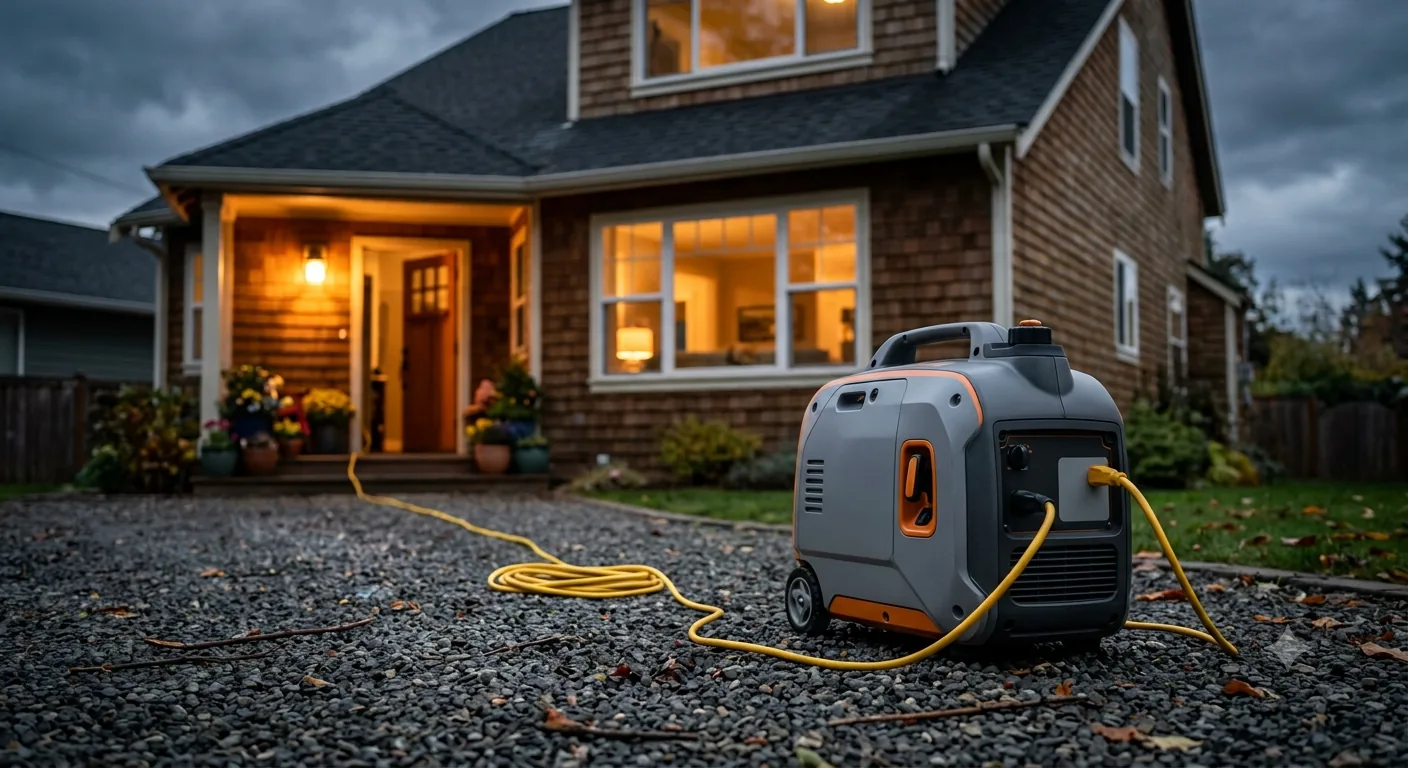
The one thing to know: A generator's dB(A) rating is only meaningful alongside the distance it was measured at, because sound intensity falls off with distance under the inverse-square law: moving twice as far away roughly halves perceived sound energy, a drop of about 6 dB. An informal industry norm has settled on 23 feet (7 meters) as a comparison distance, but it is NOT an enforced standard — some manufacturers state it, some test closer (making their number look louder than it would be at 23 ft), and many don't disclose a distance at all, which makes their number impossible to compare fairly to one that does.
Rough price bands only (no exact figures — check current Amazon pricing): budget roughly under $400, mid-range roughly $400-$700, premium roughly $700+.
Our picks — ranked by output and noise-spec verifiability
Research-based picks (how we evaluate), compiled from manufacturer specs and generator-sizing references, not hands-on load/sound testing. Live Amazon search links, no product prices or ratings, an honest drawback on each.
Honda EU2200i
2200W surge / 1800W rated, ~48-57 dB(A) claimed at 7m/23 ft depending on load, ~8.1 hr runtime @ 25% load
One of the very few makers that states BOTH the load condition and the 23 ft test distance for its dB(A) claim, which is why it anchors most third-party noise comparisons.
Best for: Buyers who want the most verifiable noise spec in the category and don't need more than ~1800W continuous
Watch out: 1800W continuous is enough for a fridge or a few essentials, not a sump pump AND a fridge together — check the Startup Watt Index before assuming it covers your motor loads, and the premium price reflects the brand more than raw output.
Check price on AmazonNot deciding today? Add it to your cart over there — Amazon keeps it saved (and flags any price change) until you're ready.
Yamaha EF2000iSv2
2000W surge / 1600W rated, ~51.5-61 dB(A) claimed at 7m/23 ft across load range, ~10.5 hr @ 25% load
Yamaha states a load-dependent dB(A) range at the same 23 ft distance Honda uses, making it one of the few pairs of competitors that are honestly comparable to each other.
Best for: Buyers cross-shopping against the Honda EU2200i who want an apples-to-apples noise comparison
Watch out: 1600W rated output is modest — it will not start most well pumps or a window AC unit alone; pair with the Startup Watt Index before buying for a specific appliance.
Check price on AmazonNot deciding today? Add it to your cart over there — Amazon keeps it saved (and flags any price change) until you're ready.
Westinghouse iGen2200
2200W peak / 1800W rated, ~52 dB(A) claimed (distance commonly cited around 20 ft, not always restated as 23 ft), ~12 hr @ 25% load
Competitive rated wattage and runtime at a lower price than Honda/Yamaha, with a published dB(A) figure that is close to (but not identically specified at) the 23 ft industry norm.
Best for: Budget-conscious buyers who still want a published, load-stated dB(A) figure
Watch out: Because the exact test distance isn't always restated consistently across Westinghouse's own materials and retail listings, treat the 52 dB(A) figure as approximate rather than a like-for-like match to a 23 ft-stated competitor.
Check price on AmazonNot deciding today? Add it to your cart over there — Amazon keeps it saved (and flags any price change) until you're ready.
Generac GP2200i
2200W starting / 1700W rated, dB(A) claims vary widely by source (roughly 50-64 dB(A) depending on load and who measured it), ~10.75 hr @ 25% load
Wide retail availability and a reputable generator brand name at a lower price point than the Japanese-made inverter leaders.
Best for: Buyers prioritizing price and brand-name parts availability over the tightest possible noise spec
Watch out: Generac's own marketing dB(A) figure and third-party load-tested measurements diverge more than for Honda/Yamaha, and the test distance is not consistently restated — treat any single dB(A) number for this model as a rough indicator, not a precise comparison point.
Check price on AmazonNot deciding today? Add it to your cart over there — Amazon keeps it saved (and flags any price change) until you're ready.
WEN 56235i
2350W peak / 1900W rated, ~51 dB(A) claimed at quarter load, test distance not consistently stated in spec materials, ~6 hr @ 25% load
One of the lowest-priced true inverter generators with a clean sine wave output suitable for sensitive electronics.
Best for: Budget buyers who mainly need clean power for electronics and light loads, not motor-starting headroom
Watch out: The published dB(A) figure does not consistently state its test distance across WEN's own materials, so it should not be treated as directly comparable to competitors that do state 23 ft — see the Noise Normalization Index for why this matters.
Check price on AmazonNot deciding today? Add it to your cart over there — Amazon keeps it saved (and flags any price change) until you're ready.
Predator 3500i
3500W peak / 3000W rated, dB(A) claims around the high-50s per retail/aggregator sources, exact test distance not consistently published
More continuous wattage headroom than the 2000W-class inverters above, useful for a fridge plus a sump pump together.
Best for: Buyers who want inverter-clean power with enough rated wattage to cover two mid-size motor loads
Watch out: As with most non-Honda/Yamaha models, the exact test distance behind the published dB(A) figure isn't consistently restated, so don't assume it's a like-for-like match against a 23 ft-stated competitor's number.
Check price on AmazonNot deciding today? Add it to your cart over there — Amazon keeps it saved (and flags any price change) until you're ready.
Frequently Asked Questions
Roughly speaking: budget models (WEN, Generac GP2200i) sit in the lower band, mid-range Japanese-made units (Honda, Yamaha) sit in a premium band roughly double the budget models, and higher-output units like the Predator 3500i sit in between depending on output. Check current Amazon pricing directly — we don't publish exact prices since they change constantly.
If you're powering sensitive electronics, camping/RV use where noise matters, or want the cleanest possible power, inverter is worth the premium. If you mainly need raw backup wattage for a well pump or central AC and don't mind more noise, a conventional or dual-fuel unit (see our dual-fuel guide) may be more cost-effective per watt.
Honda's EU2200i and Yamaha's EF2000iSv2 both state a load condition AND a 23 ft test distance, which is why they anchor most fair noise comparisons in our Generator Noise Normalization Index. Several budget competitors publish a bare dB number with no stated distance.
The 2200W-class units (Honda, Yamaha, Westinghouse, Generac, WEN) are sized mainly for a single motor load plus some resistive load — check the Startup Watt Index before assuming one covers a fridge AND a sump pump simultaneously. The higher-output Predator 3500i has more headroom for two moderate loads.